



Yoni Netanyahu was born in New York and grew up between America and Jerusalem, a reader and a writer of long letters who could as easily have become an academic. He fought in the Six-Day War as a paratrooper, was badly wounded in the elbow, went to Harvard, could not settle, and came back to the army. By 1975 he commanded Sayeret Matkal, the general staff reconnaissance unit — Israel's equivalent of the SAS.
On 27 June 1976 an Air France flight from Tel Aviv was hijacked by Palestinian and German militants and flown to Entebbe in Uganda, where Idi Amin gave the hijackers the run of the old terminal. The non-Israeli passengers were released; a hundred and six hostages, most of them Israeli, were held with a deadline for executions.
The plan Netanyahu helped build was audacious to the point of absurdity: four Hercules transports flying four thousand kilometres at low level down the length of Africa, landing in the dark at an airport with no assistance, driving off the ramp in a black Mercedes and two Land Rovers made up to look like Amin's own motorcade, and assaulting the terminal before anyone could reach a trigger.
It worked. From landing to the last aircraft leaving took ninety-nine minutes. Of the hundred and six hostages, a hundred and two came home. All the hijackers and dozens of Ugandan soldiers were killed, and eleven Ugandan fighter aircraft were destroyed on the ground to prevent pursuit.
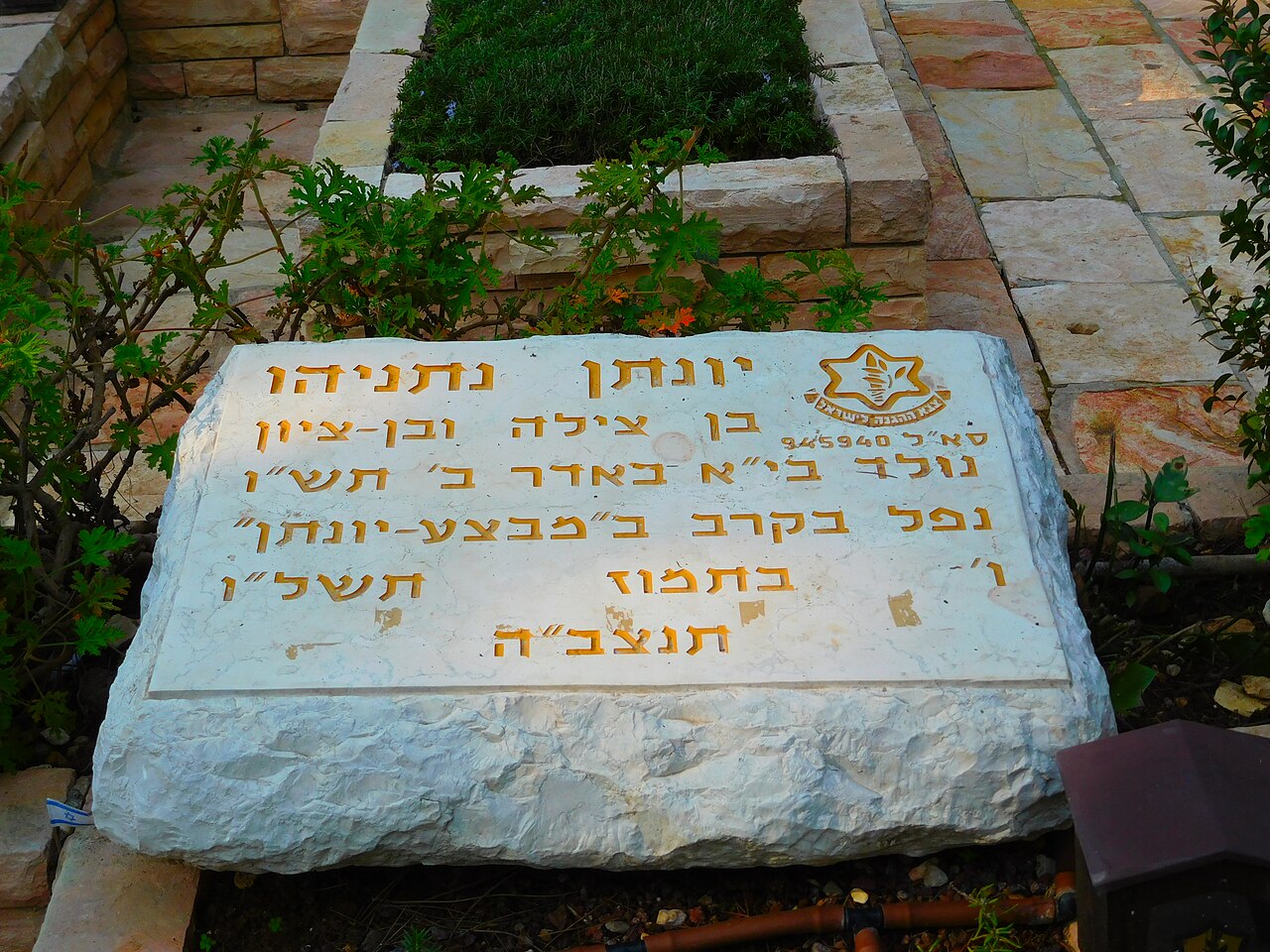
Netanyahu was hit in the chest by fire from the control tower as he led the assault element across the apron. He was thirty and the only Israeli soldier killed in the operation. Israel renamed it Operation Yonatan. His letters were published after his death and are still read; his younger brother Benjamin went into politics.
Foto: Wikimedia Commons · Wikipedia